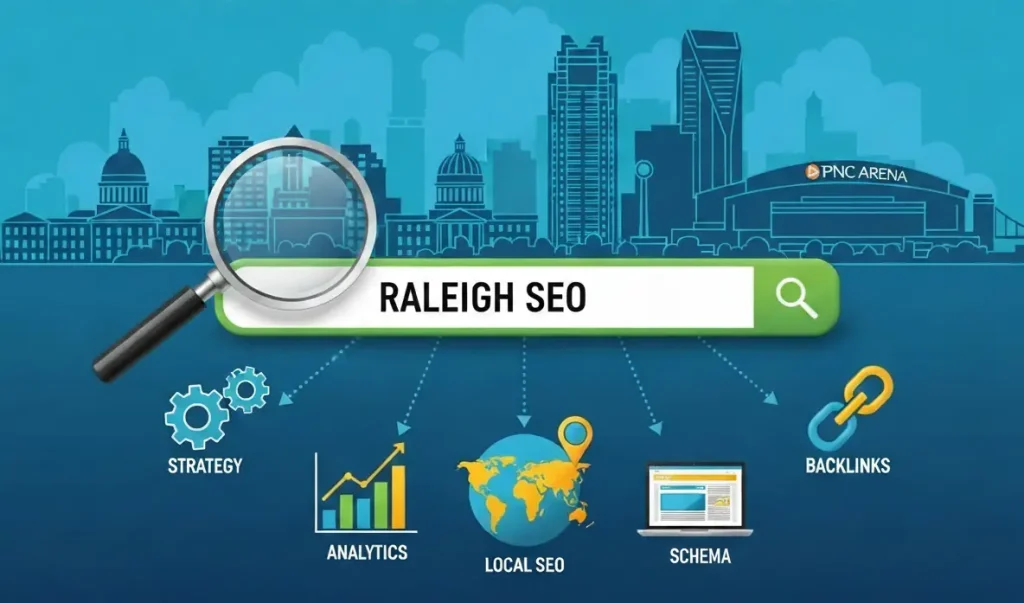
So you have a website, but how do you get it to rank well in online search engines and directories? Unfortunately, this is often no easy task. Each type of business faces a different degree of challenge in achieving the desired high-level rankings, based on the extent of its competition. This can be a tough battle, but we’ve developed several tips below to help you stay on top of your online marketing strategy.
Natural (Organic) Search Engine Ranking:
There are two fundamental principles to understand regarding your ranking for natural, or organic, search engine placement:
- Ensure your website contains the key phrases your potential visitors are searching for.** This is often accomplished by generating unique, quality content for your website’s blog. It’s important to maintain an ongoing content strategy that builds compelling posts answering questions your typical client or customer may ask. This information needs to be formatted to be indexed properly by search engines as well as AI.
- Build as many links to (incoming) your website from other websites.** This is where link building (discussed below) becomes essential.
Search Engine Optimization Tips:
- Put key words in the title tags and H1 headers for all your pages.
- Get links to your site listed on as many other sites as possible. Search engines look at how many sites point to yours to determine your site’s popularity. There are tons of free directories out there that will link to your site id you great a profile there. Some are linked to below. Make sure any incoming links pointing to your site contain your key words in them. Avoid “click here” links, as they don’t tell search engines what that link points to. Think about other businesses that are synergistic with yours, and ask them if they would consider promoting or linking to one of your blog posts. That shows that they trust you and like your content, which is what search engines want to see.
Free:
Not Free, But Worth It!
- CitySearch – We’ve witnessed various levels of success with Citysearch, depending on the type of business – definitely worth a look!
- Yellow pages – Another site that gets a lot of hits
- Angie – A great directory of local service companies
Link Building Code Generator – FREE!
When you get other sites to link to yours, provide them with code like this, which includes keywords in the link as well as the “title” parameter:
<a title=”Page Progressive – Print design, web design and web hosting in Raleigh NC.” href=”http://www.pageprogressive.com” >Page Progressive – Print design, web design and web hosting in Raleigh NC.</a>
If the above code doesn’t make sense to you, we’ve developed a web application to simplify link creation for your link-building efforts. Use our tool to generate code for sharing with others who will link to you, ensuring you get the most SEO value. Bookmark this page and use it when requesting links from others. Also, check out our FREE title and meta tag generator.
Don’t forget to read this article from our blog that talks about online syndication (Atom/RSS), which greatly improves search engine rankings. AI tools such as ChatGPT, Claude, and Gemini can be invaluable when it comes to quickly generating effective meta descriptions and titles for your pages.
 Additional SEO Best Practices

- Keyword Strategy – Repeat key phrases throughout your site naturally. For example, if you are a web design company, incorporate phrases like “We are an excellent website design company offering the best services for websites, web hosting, and web development.”
- On-Page Optimization –
- Use links, bold text, italics, and heading tags around your keywords throughout your site.
- Ensure you use ALT tags on images that contain relevant keywords.
- Meta Tags
- Use meta tags in your HTML section to list your keywords and site description for search engines. Even though meta keywords tags don’t carry as much weight with search engines anymore, it’s still good practice to use them.
- Meta descriptions are often displayed on search results pages, so word them carefully with the objective of encouraging someone to click on your link.
- Include multiple versions of words like “web site” and “website,” or “ecommerce” versus “e-commerce.”
- You may even want to include commonly misspelled words as keywords on your site.
- Keyword Density
- You can repeat your keywords throughout your site, but don’t overdo it. If you list your keywords repetitively 100 times, search engines will consider this keyword stuffing and may penalize your ranking. Use common sense.
- Site Structure
- Sitemaps help search engines discover all of your pages.
- Domain Strategy
- Acquire a domain for your website that contains your keywords. For example, if you are a web design company, consider a domain like web-design.com. You’ll benefit from people who accidentally type keywords into the URL bar in their browser, and domain names with keywords in them inherently tend to outrank domains with unrelated words.
Local SEO, AEO, GEO, and Schema Markup: Modern SEO Essentials
In today’s search landscape, optimizing for traditional organic search results is only part of the equation. With the rise of voice search, AI-powered search assistants, and hyper-local search results, businesses must adapt their SEO strategies to remain competitive.
Local SEO: Dominating Your Geographic Market
Local SEO focuses on optimizing your online presence to attract customers in your specific geographic area. This is particularly crucial for businesses with physical locations or those serving specific regions.
Key Local SEO Strategies:
- Claim and fully optimize your Google Business Profile (formerly Google My Business)
- Ensure NAP (Name, Address, Phone) consistency across all online listings
- Add high-quality photos of your business, products, and services
- Encourage and respond to customer reviews
- Post regular updates about your business offerings, events, or promotions
- Select accurate business categories and attributes
Local Citations
- Build citations in quality local directories (Yelp, Yellow Pages, chamber of commerce websites)
- Ensure consistency in your business information across all platforms
- Focus on industry-specific directories relevant to your business
Local Content Creation
- Create location-specific landing pages for each area you serve
- Write blog content about local events, news, and community involvement
- Include local keywords naturally (e.g., “Raleigh web design services” instead of just “web design services”)
 AEO (Answer Engine Optimization): Optimizing for AI Search
Structure Content for Questions
- Use FAQ formats throughout your content
- Create dedicated FAQ pages addressing common customer questions
- Structure headers as questions (H2, H3 tags)
- Provide clear, concise answers immediately following the question
Featured Snippet Optimization
- Identify questions your target audience asks
- Provide direct answers in 40-60 words immediately after the question
- Use bullet points, numbered lists, and tables where appropriate
- Include “What is,” “How to,” and “Why” content formats
Voice Search Optimization
- Write in a conversational tone using natural language
- Target long-tail keywords that mirror how people speak
- Optimize for question-based queries
- Ensure your content answers the “who,” “what,” “when,” “where,” “why,” and “how” questions
 GEO (Generative Engine Optimization): Preparing for AI-Generated Search Results
Generative Engine Optimization focuses on optimizing your content for AI models like ChatGPT, Google’s SGE (Search Generative Experience), and other AI-powered search interfaces that generate synthesized answers.
Authoritative Content Creation
- Create comprehensive, authoritative content that AI models can cite
- Focus on depth and expertise rather than keyword density
- Include statistics, data, and original research when possible
- Update content regularly to maintain accuracy and relevance
Clear Information Architecture
- Organize content logically with clear hierarchies
- Use descriptive headers that summarize content sections
- Break complex topics into digestible segments
- Ensure your main points are easily extractable
Source Attribution and Credibility
- Include author bios with credentials and expertise
- Link to authoritative sources to support your claims
- Maintain transparency about your business and expertise
- Build your brand as a trusted source in your industry
 Schema Markup: Supporting E-A-T Signals

Schema markup is structured data that helps search engines understand your content better and can significantly enhance your E-A-T (Expertise, Authoritativeness, Trustworthiness) signals. Here are some essential schema types for local businesses:**
Local Business Schema
- Implement Local Business schema to provide search engines with detailed information about your business
- Include address, phone number, business hours, price range, and accepted payment methods
- Add geo-coordinates for precise location identification
- Specify your business type using the most specific schema.org type available
Organization Schema
- Define your organization’s identity, logo, social profiles, and contact information
- Establish your brand’s knowledge graph entity
- Link all your online properties and profiles
Article/BlogPosting Schema
- Mark up blog posts and articles with appropriate schema
- Include author information, publication date, and modification dates
- Add article categories and sections for better content classification
FAQ Schema
- Implement FAQPage schema on relevant pages
- Structure questions and answers clearly
- This can help you appear in rich results and voice search answers
Review/Rating Schema
- Display aggregate ratings when you have customer reviews
- Show individual review snippets where appropriate
- This builds trust and improves click-through rates
Breadcrumb Schema
- Implement breadcrumb navigation schema
- Helps search engines understand your site structure
- Improves search result display with breadcrumb trails
How Schema Supports E-A-T-T:
Expertise
- Use Person schema with author credentials and qualifications
- Include educational background and professional experience
- Link to author profiles and published works
Authoritativeness
- Implement organization schema with awards, certifications, and recognition
- Add industry affiliations and memberships
- Include mentions in reputable publications
Trustworthiness
- Use Review and Rating schema to showcase customer feedback
- Implement secure connection indicators (HTTPS)
- Add privacy policy and terms of service links
- Display contact information prominently with schema markup
Testing and Implementation:
- Use Google’s Rich Results Test to validate your schema markup
- Implement schema using JSON-LD format (Google’s recommended method)
- Monitor Google Search Console for schema-related errors
- Keep schema markup updated as your business information changes
Integrating Local SEO, AEO, GEO, and Schema
The most effective modern SEO strategy integrates all these elements:
- Start with solid local SEO foundations – Optimize your Google Business Profile and build consistent citations
- Structure content for answer engines – Create FAQ sections and answer-focused content
- Implement comprehensive schema markup – Provide search engines and AI models with clear, structured data about your business, content, and expertise
- Build E-A-T signals – Demonstrate your expertise, authority, and trustworthiness through credentials, reviews, and quality content
- Monitor and adapt – Track your performance in traditional search, local search, featured snippets, and AI-generated results
 By embracing these modern SEO practices alongside traditional optimization techniques, you’ll position your business to succeed in the evolving search landscape, whether customers find you through traditional search results, voice assistants, AI-generated responses, or local search features.